
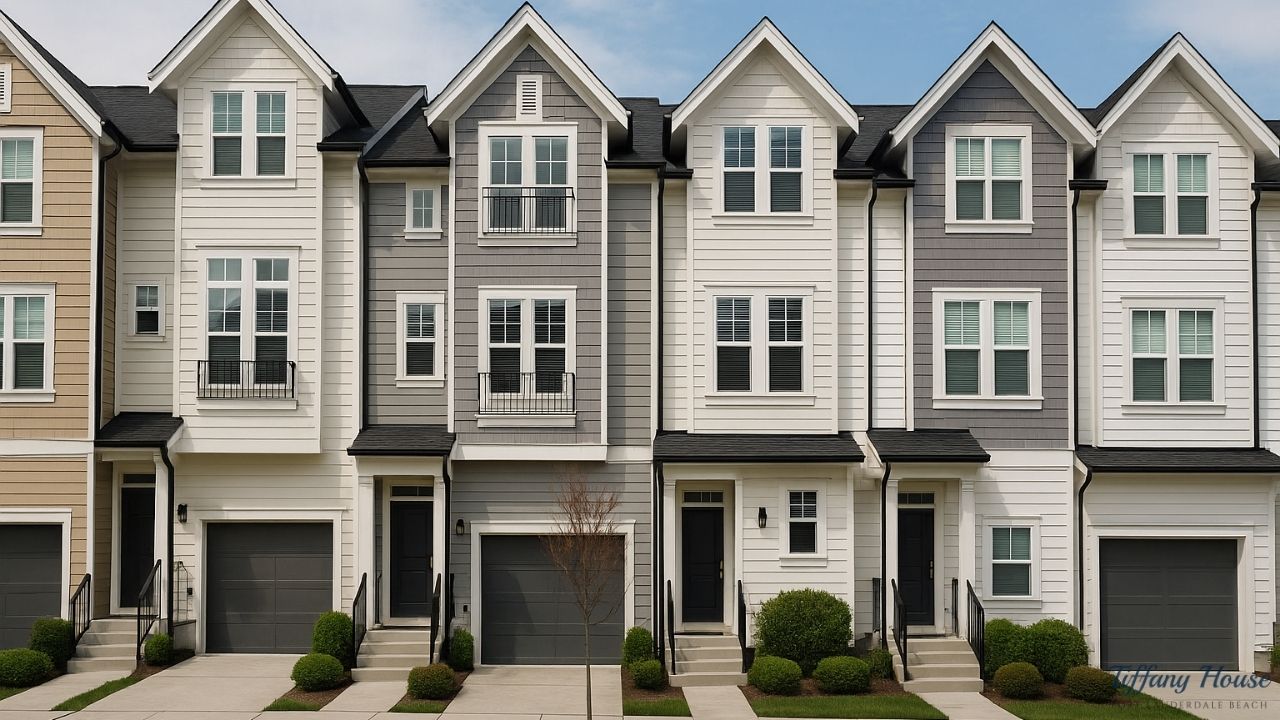
A deep dive into the pitfalls of townhouse living and what you might consider instead.
When many people shop for a new home, the attractive facade of a townhouse often makes it seem like an ideal marriage of affordability, convenience, and community. But if you peel back the surface, you’ll find serious trade-offs.
In this article, I’ll explain why you should think twice before buying a townhouse, especially if your long-term goals are investment growth, privacy, flexibility, or premium living.
If you’re instead looking for luxury condos or single-family homes in Fort Lauderdale, Florida, read on. I’ll also show you a better option at the end.
Top Reasons to Never Buy a Townhouse
1. Shared Walls
One of the structural realities of a townhouse is that you’ll share at least one, and sometimes two, walls with your neighbors. This isn’t just architectural trivia; it impacts your daily life.
- Townhouse living often means less privacy because units are attached and backyards or side lots are smaller.
- The shared‐wall design means you may hear your neighbor’s footsteps, music, conversations, or smells. The boundary between my house and our house blurs.
- Many townhouse owners feel less private in their outdoor spaces or patio areas than in their detached homes.
- In markets like NYC, wealthy buyers are reportedly moving away from townhouses primarily due to security and privacy concerns.
Why this matters: If serene indoor/outdoor living, a large private yard, or a complete sanctuary from neighbors are high on your list, a townhouse may disappoint you.
2. Limited Outdoor Space & Lot Sizes
Another hidden cost of townhouse ownership is constrained land and outdoor space.
- Many townhouses are built on smaller lots, and the outside living space (yard, garden, patio) tends to be much smaller than a standalone home.
- That limitation becomes significant if you have children or pets and enjoy activities like gardening or entertaining outdoors. As the article puts it, the limited yard size also impacts the ability to engage in creative landscaping or gardening.
- Outdoor freedom (e.g., building a pool, installing extensive landscaping, expanding) is usually more restricted.
Why this matters: Your home isn’t just indoors. If outside space is part of your vision, townhouse living may inherently force compromise.
3. Homeowners Association (HOA) Constraints, Fees & Rules
Townhouses frequently belong to communities governed by Homeowners Associations (HOAs). While HOAs have benefits, the obligations and constraints are real and sometimes subtle.
- HOA fees are additional monthly or annual costs that may become significant over time.
- HOA rules: Restrictions on exterior modifications, landscaping, parking, even when you own the unit.
- You may also find that your freedom to remodel or change exterior appearance is limited, which reduces flexibility.
- From a financing perspective, some lenders treat certain townhouse developments similarly to condos (which makes underwriting more stringent).
Why this matters: When you buy a home, you expect autonomy. With townhouses, the HOA introduces a layer of governance and cost you might skip if you purchase a single‐family detached home.
4. Slower Appreciation & Resale Challenges
If you’re buying with an eye toward investment growth (not just where to live now), townhouses often don’t perform as strongly as detached homes.
- When reselling, families will consequently experience a loss in their investment potential.
- Buyers often prefer detached homes for forever homes, meaning demand may be less for townhouses at resale.
- For investors, one piece warns that townhomes may provide a lower return on investment than single‐family homes.
Why this matters: If you buy now and plan to hold or resell later, you want strong market dynamics. Townhouses may carry built-in structural handicaps in that regard.
5. Multi-floor Layouts & Accessibility Issues
Townhouses often stack vertical floors because the footprint is narrower. While this can be efficient, it brings some drawbacks.
- Multi-story layouts mean more stairs. This can be challenging for older adults, families with very young children, or people with mobility issues.
- Because of a compact lot and efficient build, storage may be more limited (there is less basement or expansion possibility).
- The layout may feel less open or flexible than a single‐floor or detached home.
Why this matters: Your home should adapt to your lifestyle, not vice versa. If mobility, aging-in-place, or multi-generational living matter to you, the townhouse format may not be ideal.
6. Built-in Competition & Saturation
Some markets become saturated with similar units because townhouses have become popular, especially in suburban infills or urban fringe areas.
- One industry article notes that newer units can undercut older ones in pricing and value when many townhouse developments are built in the same area.
- Value can be depressed when the supply is high (multiple units with similar floor plans).
- Your unique premium may erode simply because the product becomes generic.
Why this matters: Unique homes appreciate more strongly. The upside is limited if your unit is one of many cookie-cutter townhouses.
7. Psychological / Lifestyle Trade-Offs
Owning a home is not just about four walls; it’s about how you live and feel about how you live.
- In a townhouse, you may feel closer to your neighbors to the extent of feeling less independent.
- As noted, outdoor space is limited. This affects entertaining, pets, privacy, and even the feeling of having land.
- If part of your dream was my private yard, space to breathe, and freedom to build or expand a townhouse, it may fall short of that vision.
Why this matters: If your home is supposed to reflect your lifestyle, you don’t want to buy something that constantly feels less than what you hoped for.
Ready to Elevate Your Living Experience?
Let Tiffany House help you make that move in Fort Lauderdale, ditch the townhouse regrets before they start.